Full-service Christmas light installation in Central Florida runs about $7 per linear foot along rooflines and $10 per foot on roof peaks, with most companies setting a minimum around $1,000 for a single-story house and $1,500 for a two-story. In practice that puts a typical Orlando install between $1,000 and $3,000, and large or estate properties between $2,100 and $5,000 or more.
Angi puts the Orlando average at $318. Google’s AI summary says $300 to $1,000. Both figures describe labor-only work, where someone hangs lights you already bought and leaves. Full-service installs cost more because the lights, the service calls, the takedown and the storage are in the price. Everything below covers both, so you can tell which number applies to the job you want.
Every figure on this page is sourced. Where a number comes from a Central Florida company’s published rates it says so; where it’s a national average it says that too.
The quick version
| What you’re buying | Per linear foot | What that gets you |
|---|---|---|
| Labor only — you own the lights | $1.50–$5 | Someone hangs your lights. No materials, no come-back, no takedown. |
| Full-service seasonal — the most common | $5–$12 (Central Florida: ~$7 roofline, ~$10 peaks) | Commercial LEDs cut to your roofline, clips, cords, timers, install, repairs during the season, takedown, storage |
| Permanent roofline | $15–$40 | Fixed track LEDs installed once. No annual fee. Runs all year. |
Sources: labor-only and full-service bands from HomeGuide, Ware Landscaping and Google’s AI summary; the $7 roofline and $10 ridgeline figures are published by Castle Christmas Lights, which serves Orange, Seminole and Volusia counties; permanent from HomeGuide ($20–$40) and Google’s summary ($15–$30). Angi’s Orlando page puts labor-only all-in at $1.90–$5.30.
What your house costs
Price follows linear footage. Square footage matters only as a rough predictor of it.
| Your house | Roughly | Full-service |
|---|---|---|
| One story, 1,500–2,500 sq ft | 120–200 ft of roofline | $1,000–$2,000 |
| Two stories, 2,500–3,500 sq ft | 200–300 ft | $1,500–$3,000 |
| Big or custom, 3,500+ sq ft | 300–500+ ft | $2,100–$5,000 |
| Estates — Isleworth, Golden Oak, Keene’s Pointe | 500+ ft | $5,000+ |
Those bands are the Central Florida per-foot rates above applied to typical rooflines, with the published $1,000 and $1,500 minimums as the floor. They line up with the wider market: Ware Landscaping puts 200–300 feet at $800–$2,500 and 300–500 feet at $2,000–$5,000+, Google’s summary puts a medium two-story at $800–$2,500 and a large property at $1,500–$5,000+, and HomeGuide’s by-story ranges run $250–$2,400 for one story and $500–$3,600 for two.
Anything off the roofline is priced separately:
| Typical | Source | |
|---|---|---|
| Small tree, around 6 ft | $75–$125 | Fixr |
| Medium tree, 12–18 ft | $125–$250 | Fixr |
| Large tree or oak, 28 ft+ | $300–$1,500 | Fixr; Angi’s Orlando page caps at $1,140 |
| Shrubs and hedges | $8–$20 each | Angi Orlando $8–$15; national $10–$20 |
| Driveway or walkway lining | $50–$140 | Angi Orlando |
| Wreaths and garland | $300–$700 | Google’s AI summary |
| Timers and app controls | $10–$50 | HomeAdvisor, Fixr |
| Lift hire, if your trees need one | $400–$700 | Fixr |
Tree pricing is the widest range on the page because a tree covers everything from a six-foot ligustrum to a forty-foot live oak that needs a lift to reach.
Where the $318 figure comes from
Lead-generation sites average whatever gets booked through their platform. Most of that volume is one job: someone hangs two strands you already own on a one-story roofline, and takedown is your problem. That job costs about $300 and it suits plenty of houses.
The $300 version means you bought the lights, usually retail-grade, which give you two or three seasons before the color goes patchy. You store them in the garage. A run that dies halfway through December puts you on the ladder in the dark. They come down when you get round to it, which for a lot of houses is March.
A full-service install is a different scope. The lights are commercial-grade, cut to your roofline, and replaced by the company as they age, so you never buy a strand. Clips, cords, stakes, timers and power management are included. An insured crew installs with proper roof gear. A failure in December gets a service call, usually inside a day or two. In January the crew pulls everything down, checks it over, and stores it off-site until November.
That is three to five times the work, which is why it costs three to five times as much. Compare quotes against other quotes for the same scope.
The published numbers back this up. Angi’s Orlando page breaks its $318 average into $0.40–$1.50 a foot in materials and $1.50–$3.80 in labor, which is the cost shape of a labor-only job with cheap lights. Full-service companies serving this area publish $7 to $10 a foot and set four-figure minimums. Those aren’t competing estimates of the same service. They’re prices for two different ones.
Orlando also runs above national averages because of the roofs here. Central Florida builds in barrel tile and concrete tile, and crews can’t walk tile the way they walk shingle — it cracks underfoot, and a cracked tile in December leaks in January. Tile installs need different clip hardware, more ladder and lift work, and more insurance. HomeAdvisor puts a 20% surcharge on high or hard-to-reach rooflines, and Fixr raises its per-foot band from $2–$5 to $3.50–$6 on difficult roofs. Two-story entry peaks and multi-gable rooflines are standard in this market as well, and both add time per foot. They are especially common across Dr. Phillips and Winter Garden. That’s also why local companies price peaks at $10 a foot against $7 for a straight gutter run.
Labor rates are part of it too. Orlando installers advertise crew wages of $16 to $20 an hour for seasonal work that involves towable lift operation, and a two-person crew on a tiled two-story can spend most of a day on a house.
What moves your number up or down
Footage. Every run you want lit, measured end to end. Rooflines, peaks, porch edges, the garage return everyone forgets.
Height and pitch. A single-story fascia run is quick work. A second-story gable over a tiled entry needs different equipment. Three stories is its own pricing tier, and the aggregators price it that way: HomeGuide runs $750–$5,000 for three stories against $250–$2,400 for one.
Roof material. Tile costs more than shingle, for the reasons above.
Bulb type. C9s read bigger from the street and cost more per foot than minis. A 25-foot C9 strand runs $10–$70 in materials against $6–$20 for incandescent minis. Color-changing strands run $18–$60.
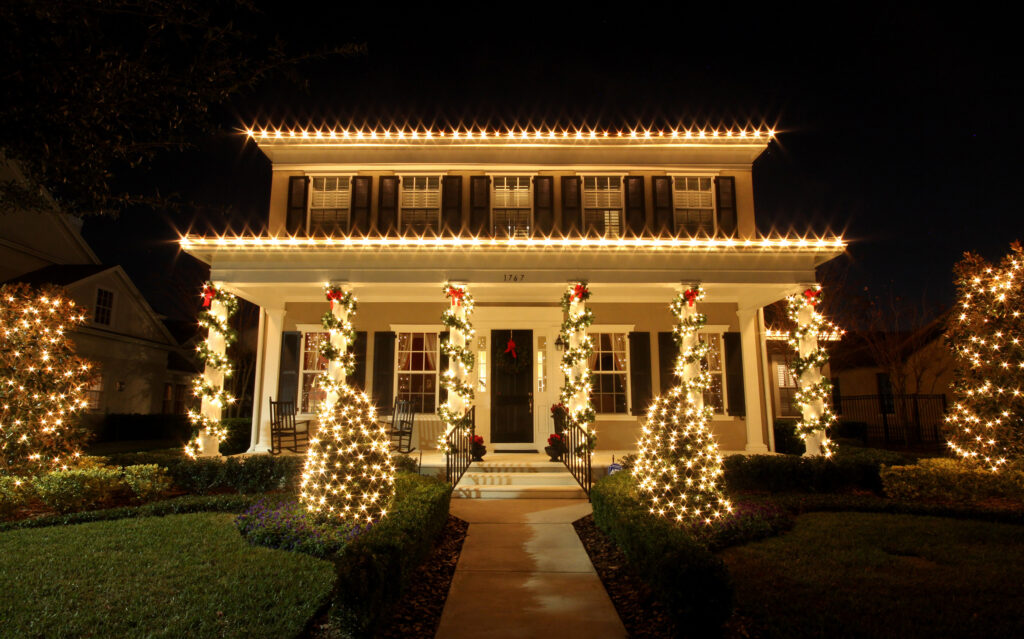
How much design is in it. A clean roofline outline is one job. Rooflines plus wrapped trees, lit shrubs, garlanded columns and a walkway is a design job and gets priced like one. HomeGuide separates these as a basic roofline at $250–$1,500 and a full package at $750–$5,000.
Access. Gated courtyards, screened pool cages, mature landscaping in front of where the ladder goes, side yards you can barely walk down. All of it adds time.
Whether takedown is in the price. Ask this one out loud. Removal on its own runs $80–$400, or $0.40–$0.65 a foot. If storage is included expect $1–$3 a foot. A quote that looks cheap for the scope is usually missing it.
Seasonal or permanent
Permanent roofline lighting costs more up front and less over time. Installed, it runs $15–$40 a linear foot, which works out to $2,000–$8,000 on a typical house. Most sources cluster tighter than that range suggests: Angi’s Orlando page lands around $2,660, Fixr puts it at $3,000–$3,500, and HomeAdvisor’s average is $3,500.
Against a seasonal install at $1,000–$3,000 a year that generally creeps up, break-even usually falls in year two or three. On a $3,000 permanent system against a $1,200 seasonal fee, you’re even partway through year three and ahead after that.
Permanent systems also run the rest of the year: orange and purple at Halloween, red white and blue in July, team colors on a Saturday, warm white accent lighting in February because the house looks better with it. A seasonal install covers about six weeks. Running cost is negligible — one Central Florida estimate puts a 150-bulb permanent system at about $4.34 a month at $0.16 per kWh.
Permanent suits homeowners staying three years or more who’d use the lighting outside December. Seasonal suits renters, anyone likely to move, and people who want a different look each year.
Reading a quote properly
Get these five in writing from everyone you talk to. If you want your own footage measured and priced, ask for a quote.
- Total footage they’re lighting, and which runs that covers
- Who owns the lights, and if it’s the company, what happens when a strand dies
- Whether takedown and storage are in the price, and roughly when takedown happens
- How fast someone comes out if something fails mid-season, in days
- Proof of liability insurance and workers’ comp
Insurance matters most of the five. This is ladder work on wet tile in December, and an uninsured crew injured on your roof becomes your problem.
A quote well under $1,000 for a full-service two-story install is worth a second look. Either the footage has been underestimated, the lights are yours to buy, or takedown isn’t in it.
Questions we get asked
How much does Christmas light installation cost in Orlando?
Full-service installation in Central Florida runs about $7 a linear foot on rooflines and $10 on roof peaks, with minimums around $1,000 for a single-story house and $1,500 for a two-story. Most Orlando installs land between $1,000 and $3,000. Labor-only work, where you supply the lights, averages $318 in Orlando according to Angi.
What’s the per-foot rate?
Labor-only runs $1.50–$5 a foot. Full-service including commercial-grade lights runs $5–$12 nationally, and Central Florida companies publish about $7 for roofline and $10 for peaks. Permanent track lighting runs $15–$40 a foot installed.
Why is my quote higher than the average I found online?
Angi’s $318 Orlando average is built mostly from labor-only jobs, and it breaks down to $0.40–$1.50 a foot in materials and $1.50–$3.80 in labor. Full-service installs include commercial lights, mid-season service, removal and storage, and are priced at $7–$10 a foot with four-figure minimums. Different services, different prices.
Does the price include taking them down?
With a full-service installer it should, though ask directly. Priced separately, removal runs $80–$400, or $0.40–$0.65 a linear foot. Expect $1–$3 a foot where off-season storage is included.
When should I book?
Mid-October if you can. Central Florida installers typically run a September-to-December season and schedules fill through November. Search demand for installers peaks in November, so everyone else is calling then too.
Is permanent cheaper in the long run?
Usually, for homeowners staying three years or more. Permanent costs $15–$40 a foot once, typically $2,600–$3,500 installed, against a seasonal fee of $1,000–$3,000 that recurs and tends to rise. Break-even lands in year two or three, and permanent lighting runs year-round rather than six weeks.
Do I need an electrician?
Not for standard plug-in installs, which run off existing exterior outlets and timers. Hardwired permanent roofline systems do need licensed electrical work, billed at $50–$100 an hour. Adding an exterior outlet runs $120–$200.